 MIC-O-SAY
was developed by the legendary Scout Executive, H. Roe Bartle. He was a
Scoutmaster in 1922 and later Scout Executive of the Central Wyoming Council
with headquarters in Casper, WY. While Scout Executive in Wyoming, Bartle
was in charge of Camp Carey, he started the Tribe of Micosay (the hyphens
were added later). Bartle was friends with local Native Americans. An
Arapahoe Chief, (Lone Bear) became interested in Scouting and started
troops. Bartle and Lone Bear became best friends. Bartle communicated not
only with Lone Bear, an Arapahoe, but also with representatives from the
local Shoshone and Lakota tribes. When Bartle left Wyoming he was honored by
Chief Lone Bear to become a full fledged Chief in the Arapahoe Tribe.
Micosay has a rich-authentic Native American tradition. MIC-O-SAY
was developed by the legendary Scout Executive, H. Roe Bartle. He was a
Scoutmaster in 1922 and later Scout Executive of the Central Wyoming Council
with headquarters in Casper, WY. While Scout Executive in Wyoming, Bartle
was in charge of Camp Carey, he started the Tribe of Micosay (the hyphens
were added later). Bartle was friends with local Native Americans. An
Arapahoe Chief, (Lone Bear) became interested in Scouting and started
troops. Bartle and Lone Bear became best friends. Bartle communicated not
only with Lone Bear, an Arapahoe, but also with representatives from the
local Shoshone and Lakota tribes. When Bartle left Wyoming he was honored by
Chief Lone Bear to become a full fledged Chief in the Arapahoe Tribe.
Micosay has a rich-authentic Native American tradition.
The name Micosay is interpreted as meaning; “being deep and abiding
friendship with warmth of heart to reach down and lift up those who are
younger and weaker”. In later years MicoSay has been shortened to mean
“Friendship and Warmth”, but the theme of helping others is still stressed.
In 1925 Bartle became Scout Executive of the St. Joseph, MO. Council, Camp
Brinton. St Joseph had an earlier group named Manhawka. Bartle quickly
incorporated his Native American themes in Manhawka. The new organization
would be a Native American-like society based on the principals of the Scout
Oath. It would become a brotherhood of leaders and leadership. At this time
Micosay was interpreted as “Friendship and Leadership”. At Camp Brinton the
positions of Brave, Warrior and Chieftain first appeared as well as the
first MicoSay Chief, Chief Lone Bear.
Bartle became Scout Executive in Kansas City in 1929. He brought two
Mic-O-Say Tribesmen with him as Scouting professionals. It was at this time
that the hyphens were added to the name. Mic-O-Say was adopted at Camp
Sayre. The area around Camp Sayre was becoming a tourist area with cottages.
In 1930 a more remote and larger camp was founded on the Osage River near
Osceola, MO. Camp Osceola became the Mic-o-Say Reservation. The Mic-o-Say
history is well documented and preserved, but this should give you a feel
for it’s founding.
In doing this research I am in awe of H. Roe Bartle. Some of our Scouting
luminaries credentials aren’t so impressive upon careful investigation. Dr.
James E West received a Honorary Doctorate from a small college and
thereafter he was DR. West. E U Goodman received a similar Honorary
Doctorate from a more obscure college and thereafter he was DR. Goodman.
Bartle wasn’t a doctor, but he was the real deal in the Scouting world. He
graduated college as an Attorney. Like many early scouting volunteers he
planned to devote a few years to scouting and later pursue a law practice.
But, he loved Scouting and never practiced Law. He had a gift for leadership
and became a beloved scouting professional. He was a large gregarious man
with a booming voice. A natural charismatic leader of boys and men. He was
so popular that in 1955 he was elected, Mayor of Kansas City. Kansas City
had been a notoriously corrupt city, run by the Democratic, Pendergast
organization. Bartle ran as an independent and served two terms. When Lamar
Hunt brought a NFL football team to Kansas City, (1963), it was named the
Kansas City Chiefs. Not for a Native American figure, but for Chief Bartle.
One of Bartle’s achievements that’s often overlooked is his incredible
leadership ability for the Kansas City BSA Council. When he came to Kansas
City the council had 2200 members. Twenty six years later when he retired
the council had 30,000 members. The camp was paid for and the budget was
balanced. Very few Scout Executives remain in a council for twenty six years
and such oversee phenomenal growth.
Mic-O-Say is active in Pony Express and Heart of America Councils, but it’s
influence extends to dozens of councils in the Great Middle West. I can’t
find information on Mic-O-Say in Western, Colorado, but their OA Lodge (541)
is Mic-O-Say.
The Mic-o-Say program is complex and partially shrouded in mystery. It’s
been difficult to research and those I contacted didn’t want to break their
vow of secrecy. They use totem poles which makes me think of the Nani Ba Zhu
program. Their ceremonies are magnificent. One of the strengths of the
program is that there are numerous things for the fledgling Mic-o-Say
candidate to do. Lots of challenges and opportunities to keep members
active. They often have 1000+ tribesmen at functions.
Mic-O-Say encourages both youth and adults to participate. Scouts enter as
youth and are allowed to remain active for a lifetime. In some ways the
adults seem to hold the organization together, although it’s certainly
appealing to youth. Both youth and adults take the program very seriously.
To an outsider, it almost seems like a men’s organization into which youth
are inducted. “you’re a boy, you’re going to be a man, this is what men
do, do this” (my quote). There is no question that it works. Members of
the Tribe are called Tribesmen and many stay active for a lifetime.
I bought an badge accumulation from a Regional S E from Kansas City. He
didn’t have any OA. He told me, out here everything is Mic-O-Say.
He told of attending Regional Meetings with volunteers scouters of the
highest echelon. Bank Presidents, Presidents of Utilities and large
Corporations, corporate attorney and such. After the meeting, talk turned to
Mic-O-Say and these Captains of Industry removed their ties and opening
their shirts to reveal Mic-o-Say beads. He told me that Mic-O-Say wasn’t a
organization, it was a religion. I asked a Mic-O-Say friend about that
statement, he laughed and told me that some would say that was an
exaggeration, but not all. Members love and believe in Mic-O-Say.
There are two ranks in Mic-O-Say: Braves and Warriors/Honored Women. The two
divisions of Warriors are Hardway Warriors and Honorary Warriors. Hardway
Warriors entered Mic-O-Say before age 18. Honorary Warriors and Honorary
Women entered Mic-O-Say after their 18th birthday.
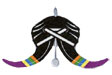
There are three categories of Paint responsibility. Working Paint for the
Hardway Warriors, the Tribal Council and the Council of Chieftans. Working
Paint for the Hardway Warriors and the order in which they are earned: |
|
|
|
|
Fire Builder
(Orange, 1st level Paint), |
 |
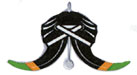
Tom-Tom Beater
(Green, 2nd level Paint), |
 |
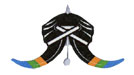
Runner
(Blue, 3rd level paint), |
 |
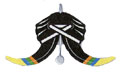
Keeper of the
Sacred Bundle
(Yellow, 4th level paint), |
 |
|
Shaman
(Purple, 5th level Purple Paint), |
 |
|
| |
|
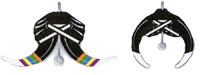
Tribal Council-White Paint; One
is first called as a Sachem, then Keeper of the Wampum, Sagamore and
Medicine Man. They all wear white Paint. Sagamores and Medicine Men
also serve on the She-She-Be Council. It is their policy to carry on
and endorse the policies of the Council of Chieftans. |
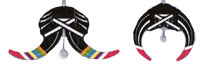
The Council of Chieftans is composed of Chiefs and Chieftans. They
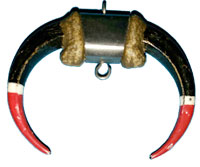
all wear red Paint and a necklace of 24 eagle claws. It is their
duty to establish policies of Mic-O-Say. The Directing Chief directs
the activities of Mic-O-Say and the Presiding Chieftans presides at
Ceremonial and Chieftan meetings. |
|
|
|
 |
 |
|
|
 |
|
|
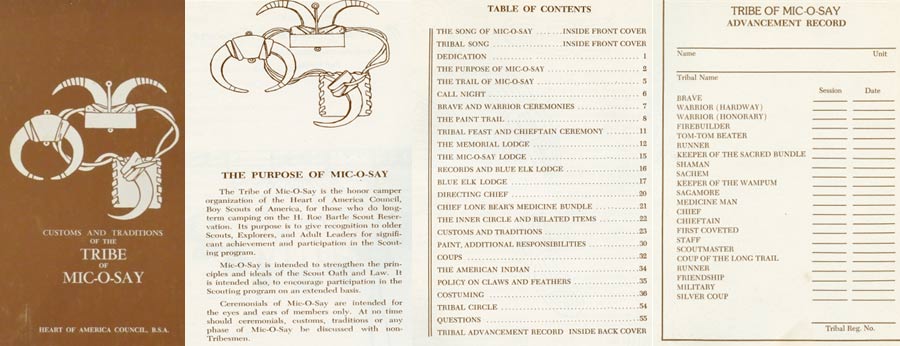
There is a wealth of printer material, most safeguarded and not for
distribution. Although I bought the 1975 brown cover booklet on e-bay. I’ve
decided not to share too much information. I am not a Tribesman, but as a
scouter I feel somewhat honor bound not to reveal too much. What is shown has
been approved by a Mc o Say Medicine Man and Chief.
|
|
|
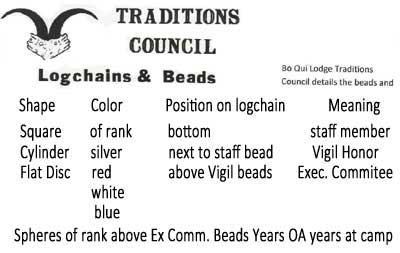
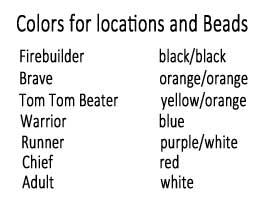
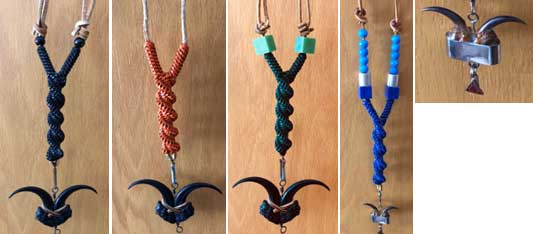
Southern Iowa Council, Camp Walepelo, used a Mic-o-say type system. Instead of
paint they had colored beads. This system was in place and used during the
period when the Order of the Arrow was active in this council. This system was
used through 1969 and perhaps later.
Southwest, Iowa council, Camp Eastman used a Mic-o-say type system. Like
southern Iowa, they used colored beads. This system was in place and was
used during a period when the Order of the Arrow was active in the council. |
|
|
  |
|
|
|
I’ve had difficulty locating the places where Mic-O-Say was active. OA Lodge 80
was chartered in 1935 yet Mic-O-Say replaced the OA, 1959 to 1964. Silver
Tomahawk OA members wear Mic-O-Say type beads to this day. Bo-Qui-Lodge (453)
used a program similar to Mic-O-Say. The information (above) is from Paul
Lewis’s book, The History of the OA in Central and
Southern, Iowa. I am checking with Silver Tomahawk members to see if they
used the same or similar color scheme. Based on the popularity and strength of
Mic-O-Say I suspect it influence camps/councils all over the Greater Central
West. OA Lodge 100 in Cape Giraradeau, MO. Incorporates a bead program. |
|
|
Paul Myers Goshen,
Indiana
gimogash@comcast.net |
|
